It looks like the American Taxpayer will finally get to see which banks got the bailout. The Supreme Court refused to hear an appeal by the Banking Industry to keep secret the details of who got what from the TARP. Thanks to Bloomberg News filing a FOIA (Freedom of Information Act) request, the Federal Reserve will have to disclose the "names and details of the banks that borrowed money from the “discount window,” where U.S. banks have turned for emergency funds — confidentially — for nearly a century."
This is just another example of the hubris and the disconnect that corporations (specifically the Banking Industry) have from Main Street and reality. When you take taxpayer (public) money to bailout a private enterprise, the taxpayers get to see who you are and what you spent it on. Once you've paid us back, then we'll get out of your business. Simple as that.
Bloomberg News, you have the thanks of a greatful taxpayer.
Showing posts with label TARP. Show all posts
Tuesday, March 22, 2011
Monday, October 25, 2010
The evil stepchildren that are TARP and the Stimulus, and why Bush would do it again
Two very good Op-ed pieces today from the New York Times. The first from Nobel Prize winning Economist Paul Krugman, countering charges from Republicans that the Stimulus was too big, it spent too much, and didn't deliver, is a bunch of baloney. As Kruman explains,
The next piece comes from New York Times Op-Ed Columnist, Ross Douthat, about the red-in-the-face anger at having to bail out Wall Street, better known as TARP. Douthat writes,
And then there's this from former President George W. Bush, coming out of seclusion, to give a speech in Tyler, TX. As reported by the Associated Press and reported by Politico,
"If Democrats do as badly as expected in next week’s elections, pundits will rush to interpret the results as a referendum on ideology. President Obama moved too far to the left, most will say, even though his actual program — a health care plan very similar to past Republican proposals, a fiscal stimulus that consisted mainly of tax cuts, help for the unemployed and aid to hard-pressed states — was more conservative than his election platform."Krugman continues to charge that the much hated Stimulus package was way too small to have the effect needed to pull the economy out of the ditch created by the Wall Street meltdown.
The next piece comes from New York Times Op-Ed Columnist, Ross Douthat, about the red-in-the-face anger at having to bail out Wall Street, better known as TARP. Douthat writes,
"The question is whether the program’s extraordinary unpopularity is justified. Few elected officials may be willing to argue for the bailout, but plenty of policy wonks will make the case (from the safety of their think tanks) that the Wall Street rescue package is actually “one of the most unfairly maligned policy initiatives of all time,” as the Center for American Progress’s Matthew Yglesias recently put it.It all comes back to what were the alternatives to either? For all the anger of the Tea Party Movement, and the jabbering of the likes of Limbaugh, Beck, Hannity, Savage, O'Reilly, and all these financial and economic experts of their ilk, still no viable alternative economic plan from the Libertarian wing of the Republican Party,... except for LET THEM FAIL and more TAX CUTS FOR THE WEALTHY. That's what would have saved our economy and prevented a "socialist government takeover" led by Obama-Pelosi-Reid.
This case was strengthened by the news that the bailout might actually end up costing the taxpayer less than $50 billion over all, rather than the $700 billion originally set aside to pay for it. Moreover, it’s the auto bailout, which the TARP funds eventually underwrote as well, that’s likely to end up being responsible for the bulk of these losses. As it stands, the federal government may actually end up turning a modest profit on the money injected into Wall Street’s failing banks.
Given what seemed to be at stake in the fall of ’08, TARP’s defenders argue, that doesn’t seem like such a bad bargain: the bailout may have averted a Great Depression, and it didn’t end up costing very much at all."
And then there's this from former President George W. Bush, coming out of seclusion, to give a speech in Tyler, TX. As reported by the Associated Press and reported by Politico,
Bush said that when the markets crashed in the fall of 2008, he recognized that if his administration didn’t do “something significant,” a “depression greater than the Great Depression” could occur.That says it all. It was that bad.
The former president said the choice to backstop many of the country’s leading financial institutions “wasn’t that hard for me.”
Thursday, July 29, 2010
The Great Recession: It could have been far worse
Conservatives can say what they want, and we will continue to haggle over what the real unemployment rate is (9.5% or at high as 16.5%), but the consensus among leading economists and financial experts continues to support the actions taken by both the Bush and Obama Administrations to prevent Great Depression 2.0.
In a report released on Wednesday, July 27, 2010, Mark Zandi (Chief Economist for Moody's Analytics) and Alan Blinder (Gordon S. Rentschler Memorial Professor of Economics at Princeton University) state that while there are good questions about the need for TARP, extending Unemployment Insurance, the Stimulus Package, Cash for Clunkers, Home Buyer Tax Credit, etc..., "it is clear that laissez faire was not an option; policymakers had to act." Zandi and Blinder go on further to conclude:
Which brings me to another point. Why haven't some of these Bankers and Hedge Fund Managers gone to jail?!!! Why hasn't there been universal, bi-partisan support for Wall Street Reform like there was back in 1934?
I think we all know the reason why. Just in case you don't here is a great article in Vanity Fair about the (Ferdinand) Pecora Commission and how it lead to the formation of the Securities and Exchange Commission and passage of the Glass-Steagall Act (strict separation of Commercial & Investment Banks).
When you totally repeal the laws that were suppose to prevent our economy from coming close to another Great Depression, and you weaken the SEC's enforcement powers, you shouldn't be surprised that we are in the shape we are in right now. So, when did all this happen? The total repeal of the Glass-Steagall Act happened in 1999 and the SEC saw it's enforcement powers steadily stripped from 2001 - 2007. In case you are wondering who was in control of Congress during those times, Republicans.
As the 2010 Mid-Term Elections get closer, you need look no further than the full-court press that Conservatives are putting on K Street donors in anticipation of the GOP taking back control of either the House or the Senate, or both. No wonder Senate Republicans refused to lift the filibuster on the most recent revision of Campaign Finance Reform.
If the GOP can overcome the Tea Party takeover and they do win control of Congress back from the Democrats, does this mean that K Street Lobbyist will be writing their legislation (again)? Does an elephant have a trunk?
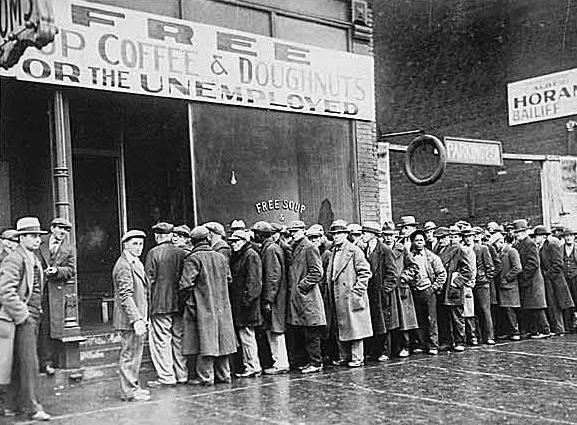
Image found at: http://riverdaughter.files.wordpress.com/2009/08/great-depression-unemployment-line.jpg
In a report released on Wednesday, July 27, 2010, Mark Zandi (Chief Economist for Moody's Analytics) and Alan Blinder (Gordon S. Rentschler Memorial Professor of Economics at Princeton University) state that while there are good questions about the need for TARP, extending Unemployment Insurance, the Stimulus Package, Cash for Clunkers, Home Buyer Tax Credit, etc..., "it is clear that laissez faire was not an option; policymakers had to act." Zandi and Blinder go on further to conclude:
"When all is said and done, the financial and fiscal policies will have cost taxpayers a substantial sum, but not nearly as much as most had feared and not nearly as much as if policymakers had not acted at all. If the comprehensive policy responses saved the economy from another depression, as we estimate, they were well worth their cost."
Which brings me to another point. Why haven't some of these Bankers and Hedge Fund Managers gone to jail?!!! Why hasn't there been universal, bi-partisan support for Wall Street Reform like there was back in 1934?
I think we all know the reason why. Just in case you don't here is a great article in Vanity Fair about the (Ferdinand) Pecora Commission and how it lead to the formation of the Securities and Exchange Commission and passage of the Glass-Steagall Act (strict separation of Commercial & Investment Banks).
When you totally repeal the laws that were suppose to prevent our economy from coming close to another Great Depression, and you weaken the SEC's enforcement powers, you shouldn't be surprised that we are in the shape we are in right now. So, when did all this happen? The total repeal of the Glass-Steagall Act happened in 1999 and the SEC saw it's enforcement powers steadily stripped from 2001 - 2007. In case you are wondering who was in control of Congress during those times, Republicans.
As the 2010 Mid-Term Elections get closer, you need look no further than the full-court press that Conservatives are putting on K Street donors in anticipation of the GOP taking back control of either the House or the Senate, or both. No wonder Senate Republicans refused to lift the filibuster on the most recent revision of Campaign Finance Reform.
If the GOP can overcome the Tea Party takeover and they do win control of Congress back from the Democrats, does this mean that K Street Lobbyist will be writing their legislation (again)? Does an elephant have a trunk?
Image found at: http://riverdaughter.files.wordpress.com/2009/08/great-depression-unemployment-line.jpg
Thursday, July 8, 2010
Don't tell the Tea Party (TARP turned a PROFIT!)
As reported on Politico's Morning Money section, the Troubled Asset Relief Program (a.k.a. TARP) has turned a profit. According to a new report issued by the Financial Analyst firm Keefe, Bruyette & Woods on July 6, 2010,... "Overall, TARP CPP investments appear to provide positive returns to the Treasury." Additionally, for the 61 banks that have fully repaid their TARP loan the average Return on Investment (ROI) was 10.3% with six having a ROI greater than 20%.
Keep in mind that TARP was a program started under the Bush Administration and carried over to the current Obama Administration. While a 15% ROI is generally considered a good measuring stick for the soundness of a good investment, at this point anything that shows positive returns from the Treasury's bailout of these badly (if not criminally) mismanaged banks and global financial firms, indications are that things are moving in the right direction.
Another bit of good financial news today comes from the International Monetary Fund (IMF). As reported by the Associated Press the IMF has raised it's 2010 World Growth Forecast, lead by the United States and China. But, the IMF does offer a bit of caution. According to Jose Vinals, who oversees the IMF's monetary and capital markets department, Europe's debt problems "could spill over to other regions and stall the global recovery."
This leads to the question that everyone that has been negatively affected by the Great Recession has asked: What would things look like and were would we be if the Federal Government hadn't enacted TARP, bailed out the American Auto Industry, or passed the Stimulus? Would we be looking at national unemployment at the levels of the Great Depression of 25% or greater if we hadn't?
Unfortunately, in may areas of the nation this is the reality. In Martinsville and Danville, Virginia the actual unemployment numbers are over 20% and 16% respectively.
For all the anger and railing against the Federal Government from the Tea Party over bailing out these financial institutions, and how the Government has done nothing but screw things up since the Obama Administration and Democrats have been in control, this strategic investment in our Capitalist system seems to be working right.
The surest way to reduce the size of the Federal Government, or any state and local government, is for unemployment to continue at the current levels of around 9.5%, or have them go higher. When people are out of work they pull back on spending and paying sales taxes, and among other things they can't pay their income and property taxes. All of these revenue sources are what funds our Federal, State, and Local governments.
Counter to the path that much of Europe is taking these days through Austerity (focusing on reducing their national debts by cutting their budgets and government services), Political Scientist and Economist Paul Krugman argues that the Stimulus was too small to begin with and we need more, not less. There is nothing more that will send fiscal conservatives and Tea Party activist into a tirade than calling for more government spending that adds to the national debt.
But, as Krugman suggests from his rounds on this past Sunday's talk shows, more government spending now could be all the difference in sustaining the recovery or having us slide into a full blown Depression. More Stimulus will not impact the level of long term national debt, which will take years to pay down.
At this point, with incumbents from both major political parties hunkering down or heading for the hills for the duration of the 2010 campaign season, the likelihood of a new stimulus package along the lines Paul Krugman is suggesting are about as likely as Rush Limbaugh, Glen Beck, and Neal Bortz becoming normal/reasonable people.
The point is that TARP is actually working and not everything that the Federal Government does turns into a train wreck. It is going to take time to correct 30 years of financial deregulation and bad monetary policy.
Photo by: http://www.treehugger.com/20090730-wall-street.jpg
Keep in mind that TARP was a program started under the Bush Administration and carried over to the current Obama Administration. While a 15% ROI is generally considered a good measuring stick for the soundness of a good investment, at this point anything that shows positive returns from the Treasury's bailout of these badly (if not criminally) mismanaged banks and global financial firms, indications are that things are moving in the right direction.
Another bit of good financial news today comes from the International Monetary Fund (IMF). As reported by the Associated Press the IMF has raised it's 2010 World Growth Forecast, lead by the United States and China. But, the IMF does offer a bit of caution. According to Jose Vinals, who oversees the IMF's monetary and capital markets department, Europe's debt problems "could spill over to other regions and stall the global recovery."
This leads to the question that everyone that has been negatively affected by the Great Recession has asked: What would things look like and were would we be if the Federal Government hadn't enacted TARP, bailed out the American Auto Industry, or passed the Stimulus? Would we be looking at national unemployment at the levels of the Great Depression of 25% or greater if we hadn't?
Unfortunately, in may areas of the nation this is the reality. In Martinsville and Danville, Virginia the actual unemployment numbers are over 20% and 16% respectively.
For all the anger and railing against the Federal Government from the Tea Party over bailing out these financial institutions, and how the Government has done nothing but screw things up since the Obama Administration and Democrats have been in control, this strategic investment in our Capitalist system seems to be working right.
The surest way to reduce the size of the Federal Government, or any state and local government, is for unemployment to continue at the current levels of around 9.5%, or have them go higher. When people are out of work they pull back on spending and paying sales taxes, and among other things they can't pay their income and property taxes. All of these revenue sources are what funds our Federal, State, and Local governments.
Counter to the path that much of Europe is taking these days through Austerity (focusing on reducing their national debts by cutting their budgets and government services), Political Scientist and Economist Paul Krugman argues that the Stimulus was too small to begin with and we need more, not less. There is nothing more that will send fiscal conservatives and Tea Party activist into a tirade than calling for more government spending that adds to the national debt.
But, as Krugman suggests from his rounds on this past Sunday's talk shows, more government spending now could be all the difference in sustaining the recovery or having us slide into a full blown Depression. More Stimulus will not impact the level of long term national debt, which will take years to pay down.
At this point, with incumbents from both major political parties hunkering down or heading for the hills for the duration of the 2010 campaign season, the likelihood of a new stimulus package along the lines Paul Krugman is suggesting are about as likely as Rush Limbaugh, Glen Beck, and Neal Bortz becoming normal/reasonable people.
The point is that TARP is actually working and not everything that the Federal Government does turns into a train wreck. It is going to take time to correct 30 years of financial deregulation and bad monetary policy.
Photo by: http://www.treehugger.com/20090730-wall-street.jpg
Subscribe to:
Posts (Atom)